legendary · Mind & Resilience · PRO deck · first card free
Cognitive biases from Thinking, Fast and Slow
Daniel Kahneman · 2011. In the app: Core Cognitive Biases.
About this deck
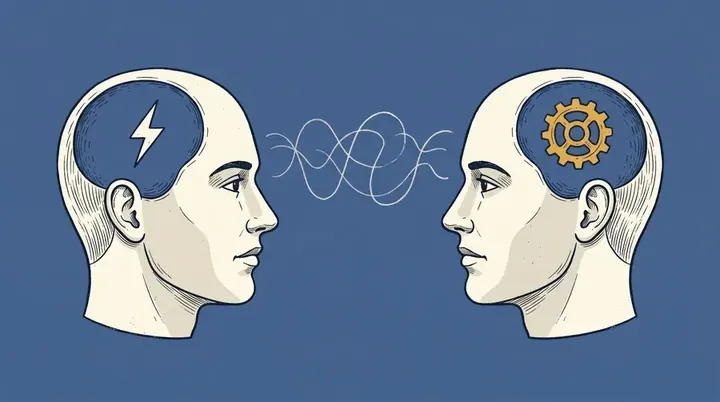
Daniel Kahneman spent decades with Amos Tversky mapping the predictable ways human judgment goes wrong, and his 2011 book Thinking, Fast and Slow brought that work to a wide audience. Its central picture is simple: a fast, intuitive mind does most of our thinking, and a slower, effortful mind checks its work far less often than we assume. This deck covers eight cognitive biases from that tradition, from anchoring to base rate neglect. After working through it, you will be able to spot each bias in a negotiation, a plan or a news story, and you will have a concrete habit for each one that protects your decisions better than willpower does.
The 8 ideas
Anchoring
The first number sets the gravity.
Anchoring bias is the pull that the first number you encounter has on every estimate you make afterward. Even an arbitrary figure becomes a reference point, and people adjust away from it too little. The reliable defense is to settle on your own number before you hear anyone else's.
Loss Aversion
Losses hurt twice as much as gains feel good.
Loss aversion is the tendency to feel a loss more strongly than a gain of the same size. Because losing hurts more than winning pleases, people cling to bad positions and avoid reasonable risks. The bias is part of how minds work, so the goal is to account for it, not to erase it.
Availability
What comes to mind feels true.
The availability heuristic is the habit of judging how common something is by how easily examples come to mind. Vivid, recent or emotional events are easy to recall, so they feel more frequent than they are. Your sense of risk can end up reflecting the news cycle rather than reality.
The Planning Fallacy
Every plan is the best case.
The planning fallacy is our tendency to underestimate how long projects will take and how much they will cost. We picture the smooth version where nothing goes wrong. The fix is to ask how long comparable projects actually took, rather than reasoning from the details of this one.
Framing
The wrapper changes the choice.
The framing effect is the way identical information leads to different choices depending on how it is presented. A treatment described by its survival rate feels safer than the same treatment described by its death rate. Since you cannot escape framing, the habit is to restate important options both ways.
The Sunk Cost Trap
Past money is past.
The sunk cost fallacy is letting money, time or effort already spent push you to keep going with something that no longer makes sense. What is spent is gone either way. A good decision looks only at what each option offers from today onward.
Confirmation Bias
You seek what you already believe.
Confirmation bias is the tendency to look for, notice and remember evidence that supports what you already believe, while brushing aside evidence against it. It is a feature of how the mind searches, not a moral failing. The defense is to seek out the best argument against your view on purpose.
Base Rate Neglect
The story drowns out the statistics.
Base rate neglect is ignoring how common something is in general when a specific, vivid description is in front of you. A detailed story feels convincing, so we forget to ask how many such cases exist. Good reasoning starts with the base rate, then adjusts for the details.
Test yourself
Two questions from the deck quiz. Pick an answer to see the explanation.
1. What is anchoring?
Show the answer
The first number you hear pulls every later estimate toward it. The anchor needn't be relevant, just first. You adjust away from it, but never enough.
2. A founder rejects a 4M offer because they once told investors the company was worth 10M. What's at work?
Show the answer
Loss aversion: the gap to an imagined 10M feels like a loss. 4M is real and 10M is not, yet the gap is felt as a loss.

Walk this deck as a journey
In CODEX, Core Cognitive Biases is a world on the map: read each card in full, earn stars in the quiz, complete the field missions and beat the boss quiz. The first card is free; CODEX PRO unlocks the rest, with a 7-day free trial on the yearly plan.